
Romania is one of the European Union’s quiet agricultural powerhouses. It leads the EU in sunflower area, ranks among the top cereal producers, and runs extensive apple and plum orchards across Transylvania and Moldavia. That scale brings pest pressure and strict EU residue rules at the same time. This Romania case study looks at how a solar insect killer fits a modern, export-oriented farm that must protect yields while keeping chemical inputs low.
Romanian agriculture spans two very different systems. Large arable estates in the south and east grow sunflower, wheat, and maize at scale, often with tight margins and rising input costs. In the hills, family and cooperative orchards grow apples, plums, and vines where cosmetic quality drives price. Both systems face night-flying moths that a solar bug zapper is built to intercept.
EU membership sets the frame. Maximum residue limits are enforced, audits are routine, and buyers in Germany, France, and the Nordics ask for residue documentation. For a Romanian grower, agricultural pest control is also a market-access strategy, not just a yield tactic.
In the orchard block of this trial, the main targets were codling moth in apples and plum fruit moth in stone fruit. In the arable block, the concern was the moth complex on sunflower and the ear-feeding caterpillars on maize. All are night-active adults that fly after dusk, mate, and lay eggs, exactly the window a solar insect killer covers.
Spraying alone had two problems. First, the moths are airborne and mobile, so fixed schedules often missed the flight peak. Second, repeated sprays raised residue and resistance risk on a crop destined for EU shelves. The grower wanted a physical control to carry the night shift.
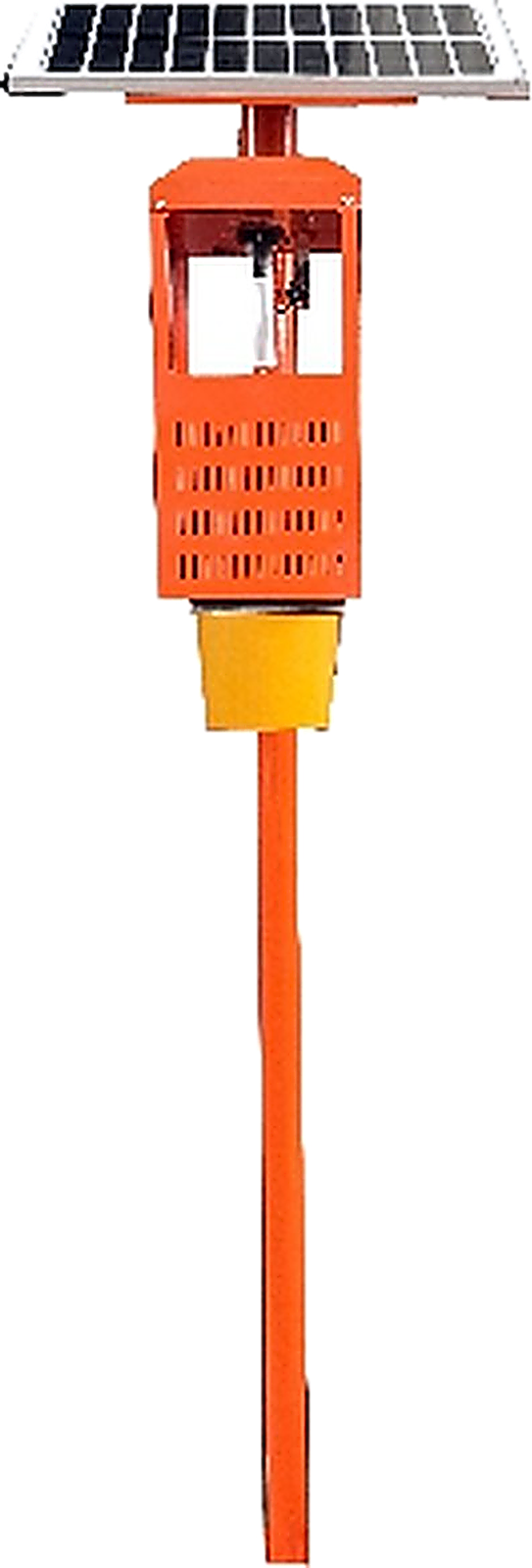
The farm installed a solar insect killer along orchard margins and at the corners of the sunflower fields. Units sat just above the canopy, switched on automatically at dusk, and ran through the monitored flight windows. No fuel, no labor at night, and no chemical residue.
For farm pest management, the traps also became a scouting tool. Catch counts from the solar bug zapper told the agronomist when flight peaked, so any supplemental action could be timed to real pressure rather than a calendar guess.
Over two seasons, the orchard block reported a clear drop in fruit with entry damage and a lower need for corrective sprays during the moth flight. The sunflower block saw steadier stand protection through the flowering window, when ear- and head-feeding moths do the most harm. Residue testing stayed comfortably inside EU limits, supporting the grower’s export contracts.
The economic case was straightforward. A solar insect killer is a multi-season asset with no recurring fuel or chemical cost, so the savings on sprays and the avoided residue risk compounded each year. In a margin-sensitive arable system, that steady reduction in input spend mattered as much as the yield protection.
This trial highlights three transferable points. First, edge placement matters: moths enter from borders and weeds, so the trap belongs at the margin, not buried in the canopy. Second, timing beats volume: running the unit through the flight peak outperforms sporadic spraying. Third, the trap doubles as data, giving the agronomist a real-time signal for any backup action.
For cooperatives, the model scales cleanly. A shared batch of units can be moved between member blocks through the season, concentrating protection where the flight is active. That flexibility suits Romanian agriculture, where small orchards and large fields sit side by side.
Romania’s mix of large arable area and quality-driven horticulture is exactly where a solar insect killer earns its place. The country’s export orientation to strict EU markets rewards low-residue methods, while its scale rewards durable, fuel-free tools. Agricultural pest control here is less about eliminating every spray and more about shifting the balance toward physical, auditable control.
The trial also shows the social angle. As labor costs rise and younger workers leave rural areas, automated nightly control reduces the dependence on manual scouting and late spraying. A solar bug zapper works whether or not a worker is in the field at midnight.



Use this guide alongside the references below to build a complete, defensible programme.
For deeper technical and regulatory context, see the FAO Integrated Pest Management and the EPA safe pest control.
Codling moth and plum fruit moth in orchards, plus the moth complex on sunflower and maize. All are night-flying adults that a solar insect killer intercepts at dusk.
No. The trap carried the night shift and cut corrective sprays, but the grower kept targeted action for confirmed hotspots. Farm pest management stayed layered.
Yes. With fewer sprays during flight, residue testing stayed inside EU limits, supporting export contracts to strict markets.
Yes. Cooperatives can share a batch of units and move them between blocks through the season, matching protection to the active flight.
The trial shows that a solar insect killer is not a niche gadget but a practical, EU-compatible layer of agricultural pest control. For growers balancing yield, residue, and cost, it turns the moth’s own night flight into the moment of control, and it does so without adding a single drop of chemical to the fruit.