
Insect growth regulators and a solar insect killer solve different problems on different timelines. One interrupts development inside the population with a chemical that mimics or blocks molting hormones; the other removes adult pests from the air with light. Both have a place in agricultural pest control, but growers choosing between them are really choosing between two philosophies. Understanding that difference is the key to a sound farm pest management plan.
IGRs are compounds that disrupt an insect’s life cycle rather than killing it on contact. Most are analogs of juvenile hormone or ecdysteroids, or inhibitors of chitin synthesis. They stop larvae from molting properly, prevent adults from emerging, or block egg development. Common active ingredients include methoprene, pyriproxyfen, and diflubenzuron.
Because IGRs act on stages that chewing or sucking insects pass through, they are popular against whiteflies, aphids, leaf miners, and moth larvae. They are usually applied as a spray or a feeder-treated bait, and they work slowly: the population declines over days to weeks as existing adults die off and no new ones mature.
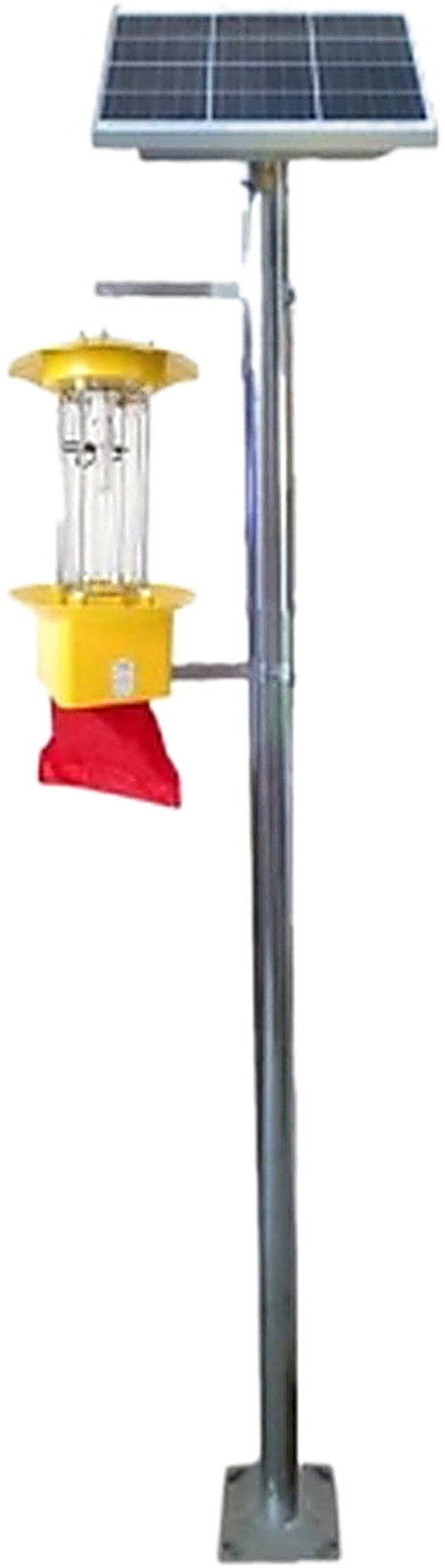
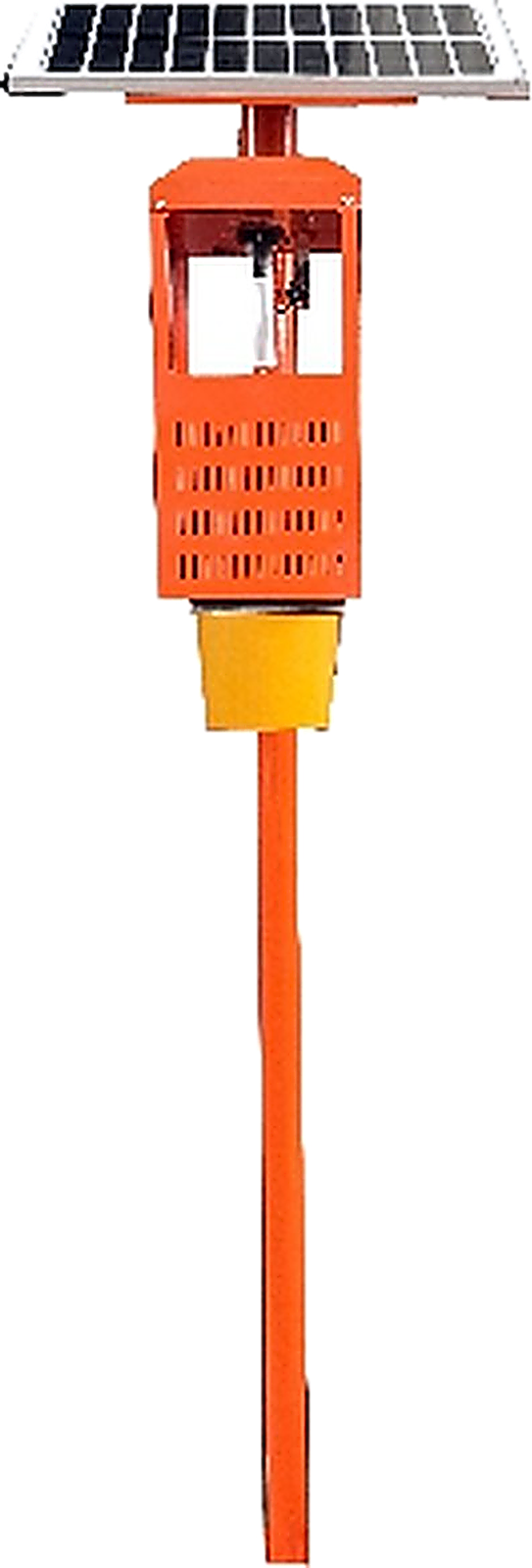
A solar insect killer takes a physical, immediate route. A UV-rich lamp draws night-flying insects to the unit after dusk, and a fan or grid captures them on the spot. There is no chemical, no waiting for a molt, and no residue on the crop. Because it runs on a solar panel and battery, a solar bug zapper operates off-grid with no fuel or daily labor.
The two tools differ in what they hit. IGRs target the immature stages hidden in leaf tissue or soil. A solar insect killer targets the flying adults moving between plants, especially at dusk. In practice, the trap reduces the number of eggs laid in the first place, while the chemical reduces the number of larvae that survive to adult.
If you need a fast drop in adult pest numbers, the trap wins. A solar insect killer removes moths and flying bugs the same night they fly, so the effect on the adult population is immediate. IGRs show their benefit later: you may not see fewer insects for one to three weeks, depending on the species and the product.
For a grower facing a sudden flight, that delay matters. Many farm pest management programs therefore use the trap as the first line during a flight peak, then rely on IGRs or biologicals to clean up the stage that stays on the plant.
This is where the two tools diverge most sharply. IGRs are chemicals, so they carry a label, a re-entry interval, and a pre-harvest interval. They leave residues that must stay below the maximum residue limits set by export markets. For growers shipping to the EU, Japan, or North America, every such application adds a residue record to the audit trail.
A solar insect killer leaves no chemical on fruit at all. It can run right up to harvest, and it needs no withholding period. That is why export-oriented farms often lean on the trap for late-season control and reserve any spray, including IGRs, for earlier windows when the residue risk can be managed.
Repeated use of a single mode of action selects for resistant pests, and IGRs are no exception. Because they target a specific hormonal pathway, overuse can produce populations that no longer respond. Insecticide resistance management guidance usually recommends rotating IGRs with products from different groups.
A solar insect killer has no chemical mode of action, so it adds no selection pressure for resistance. Adding one to a program that already uses growth regulators gives growers a way to cut the number of chemical applications per season and slow resistance build-up. That is a core reason IPM specialists treat physical traps as a resistance-management tool, not just a kill device.
Growth regulators are bought per application. The cost includes the product, the sprayer, water, labor, and repeat treatments through the season. A solar insect killer is a one-time capital purchase with no consumables beyond occasional lamp and battery service. Over several seasons, the trap often costs less per hectare, especially where electricity is unavailable.
The trade-off is coverage. One trap protects a defined radius; a spray reaches every treated surface. Most growers find the two complementary rather than interchangeable. Use the trap for continuous background suppression and monitoring, and use growth regulators only where scouting shows the trap alone is not enough.
A practical stacked plan looks like this:
1. Run the solar bug zapper every night from first flight through harvest. 2. Track nightly catches to time any intervention. 3. Apply growth regulators only when scouting confirms the larval stage is building on the crop. 4. Rotate chemical groups if more than one application is needed. 5. Conserve beneficial insects by keeping sprays narrow and infrequent.
This approach uses the trap to lower adult pressure and growth regulators to break the remaining life cycle, minimizing both residue and resistance.


Use this guide alongside the references below to build a complete, defensible programme.
For deeper technical and regulatory context, see the FAO Integrated Pest Management and the EPA safe pest control.
Not always. The trap catches flying adults but does not reach larvae inside leaf mines or fruit. Heavy internal-feeder pressure may still need a growth regulator or biological treatment.
Many are relatively selective, but effects vary by product and species. Check the label and avoid spraying when beneficials are active.
It is designed for dusk and night flight. Day-active pests are better handled by other methods within an agricultural pest control plan.
For continuous background control, the trap usually wins because there is no per-application cost. For an acute outbreak, one targeted growth regulators spray may be cheaper than buying enough traps.
The choice between a solar insect killer and growth regulators is not either-or. Used together, they cover both the flying adult and the concealed larva, giving farm pest management a program that is faster, lower-residue, and slower to develop resistance. For most commercial farms, the trap is the foundation and the chemical is the backup.