
Cutworm damage shows up overnight. A row of healthy tomato, cabbage, or corn seedlings is standing tall at dusk and cut flat at the soil line by sunrise. The culprit is a nocturnal larva that hides in the topsoil during the day and climbs to feed after dark. For market-garden and row-crop growers, it is one of the first battles of every season, and it is exactly the kind of night-feeding pest that a solar insect killer is built to intercept.
Cutworms are the larval stage of several night-flying moths, most commonly in the Noctuidae family. The larvae chew through tender stems at or just below the soil surface, toppling seedlings that cannot recover. A single larva can destroy multiple plants in one night, which is why early control protects both stand count and early-season revenue.
Unlike aphids or whiteflies that feed in place, these larvae travel. They shelter in clods, mulch, or weed fringes by day and emerge to forage at night. That behavior makes broadcast spraying inefficient: the chemical sits on foliage, but the pest is underground and active only in darkness. Agricultural pest control that ignores the night shift leaves the most damaging window unguarded.
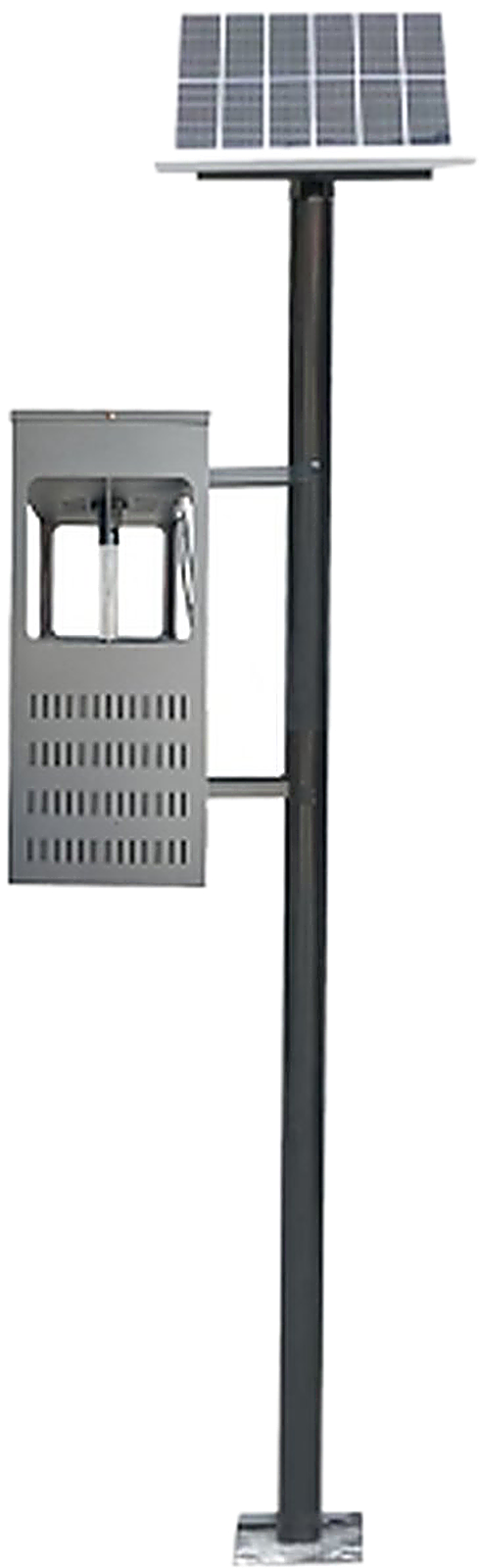
A solar insect killer does not poison the soil. It uses a UV-rich light to draw the adult moths toward the unit after sunset, then a fan or grid removes them. Because these moths are strong, night-active fliers, the trap works at the exact hour the females are migrating and laying eggs. Breaking the moth-to-egg cycle is the most durable form of cutworm control available to an organic or low-input grower.
The advantage over scheduled spraying is timing. Moths fly when conditions are warm, calm, and dark. A solar bug zapper runs on its own solar charge, switching on automatically at dusk and covering the flight window without labor or fuel. For farms that already practice farm pest management with thresholds and scouting, the trap becomes a fixed monitoring and suppression asset.
Position matters more than raw light output. The moths move from field margins, weedy headlands, and neighboring fallow ground into the crop. Place the solar insect killer:
A common mistake is mounting the unit too high. These moths fly low and skim the canopy, so a unit set at crop height often outperforms one lifted on a tall pole. Field trials on vegetable farms show the best results when traps sit just above the young plants and run every night through the flight peak.
Cutworm generations overlap in warm regions, but most damage clusters in two windows: the spring migration onto early transplants, and a late-summer generation on fall brassicas. Run the solar insect killer through both. Agricultural pest control pays off most when the trap is active before the egg-laying surge, not after seedlings are already cut.
Scout for clues: clipped stems, wilting plants with intact roots, and moths flushed from the soil when you walk the rows at dusk. Combine that scouting with trap catch counts to time any supplemental action. Farm pest management works best when the trap supplies the data and the grower supplies the decision.
A solar insect killer is one tool, not the whole plan. Build the program around several layers:
1. Sanitation: clear weed hosts and crop residues along borders where moths rest. 2. Cultural: use transplants with sturdy stems, or collar seedlings with a foil or cardboard guard at the base. 3. Biological: conserve ground beetles and parasitic wasps that prey on eggs and small larvae. 4. Mechanical: run the solar insect killer every night through the flight window. 5. Targeted: reserve any botanical or microbial product for confirmed hotspots only.
This layered approach keeps residue low and slows the resistance that comes from repeated blanket sprays. It also fits certification schemes that restrict synthetic inputs, because the solar bug zapper is a physical control with no chemical residue.
Buyers in the EU, Japan, and North America increasingly reject residue. For exporters, control that leans on a solar insect killer supports both phytosanitary quality and residue compliance. The trap is a documented physical intervention, easy to show in an audit, and it reduces the spray events that create MRL risk.
Growers shipping to strict markets report that combining edge trapping with clean borders keeps stand loss under a few percent, versus double-digit loss in unprotected blocks. That difference is often the margin between a profitable transplant window and a costly replant.
A single solar insect killer covers a defined area for several seasons with no fuel cost. Against the price of replanting a cut-over block, the unit usually pays back within one to two seasons on high-value vegetables. For farm pest management budgets, the math is simple: protect the stand once, and you avoid the labor and seed of a second planting.



Use this guide alongside the references below to build a complete, defensible programme.
For deeper technical and regulatory context, see the FAO Integrated Pest Management and the EPA safe pest control.
No. They target the night-flying adult moths before they lay eggs. Larval control comes from sanitation, collars, and beneficial insects once eggs are already in the soil.
It depends on the model’s coverage rating and field shape. Start with edge and corner placement, then add units to reach uniform light overlap in the flight zone.
Yes. The same nightly light draws many moth species, so agricultural pest control from one unit often spans several caterpillar and leaf-eating pests beyond cutworms.
For light pressure, yes. For heavy migration years, pair the trap with border sanitation and targeted products only where scouting confirms damage.
Cutworm control rewards growers who defend the night. A solar insect killer turns the moth’s own flight habit into the weakness you exploit, protecting seedlings with light instead of repeated sprays. For vegetable farms practicing farm pest management, it is one of the highest-leverage, lowest-residue tools you can deploy at the field edge.