
Fall armyworm (Spodoptera frugiperda) is one of the most damaging migratory pests on earth. Since it spread from the Americas into Africa and Asia, it has chewed through maize, rice, sorghum, sugarcane, and vegetable seedlings, wiping out a meaningful share of smallholder yields in a single season. For growers who want protection without endless spray cycles, a solar insect killer offers a safe, off-grid way to cut the adult flight before eggs are laid. This guide walks through seven practical control steps you can apply on field crops and vegetables.
A single fall armyworm female lays hundreds of eggs in masses on leaf undersides. The larvae tunnel into whorls, cobs, and growing tips, and a few individuals can destroy an entire maize plant. Because the pest moves with the wind and breeds year-round in warm regions, outbreaks arrive fast and spread faster than most spray programs can chase.
Effective agricultural pest control starts with the lifecycle. Adults are strong nocturnal fliers drawn to light; they mate and lay eggs at night, then larvae do the feeding damage by day. That means the highest-leverage moment is the adult stage, before eggs are laid — exactly where a solar bug zapper intervenes.
Economic losses are not only from direct feeding. Fall armyworm destroys the growing point of cereals, so plants may recover but produce no ear. A well-sited solar insect killer reduces the adult reservoir night after night, lowering the pressure that leads to those catastrophic whorl attacks.
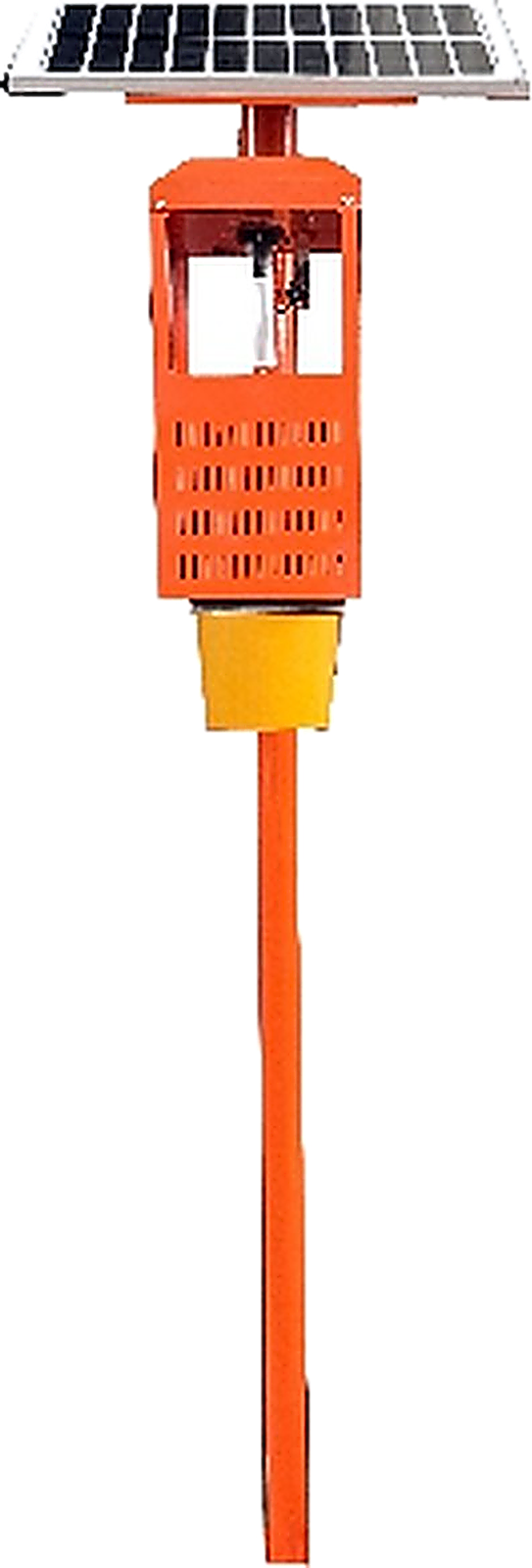
Modern units use wavelength-tuned UV LEDs to mimic the light spectrum that draws adult moths. A low-noise wind-suction fan pulls them into a collection chamber where they dehydrate. Unlike grid-zappers, this design avoids sparks and reduces risk to the beneficial insects that also patrol your field.
Because the device runs on its own panel and battery, it keeps working through outages and in remote plots. Fall armyworm moths are most active after dusk, so continuous nighttime operation is critical. A grid-independent solar insect killer never sleeps during the flight window.
Walk your maize and vegetable beds weekly and check leaf whorls, cobs, and seedling tips for eggs and small larvae. Mark hotspots on a field map. Early detection lets you place devices where moths congregate and prevents a small pocket from becoming a farm-wide outbreak.
Position each unit just above the canopy, where adult moths fly and settle. For maize, stagger units along field edges and the center rows. Correct placement is the single biggest factor in suppression, because a well-sited trap intercepts far more flying insects than one placed too high or too low.
Pheromone traps estimate adult flight trends. Use them next to your devices so you can see whether moth counts are falling. Monitoring turns control from guesswork into measurable farm pest management and tells you when to add units or shift tactics.
Where possible, adjust sowing so the most vulnerable seedling stage falls outside the peak moth flight. Pair this cultural step with your solar devices at field margins so any insects that arrive are still intercepted. Staggered planting spreads risk across the season.
Remove volunteer maize and weed hosts that feed fall armyworm between seasons. Clean borders deny larvae a place to pupate and reduce the local population that your traps must handle. Healthier field margins make your solar insect killer program more efficient.
Parasitic wasps, predatory beetles, and spiders attack eggs and larvae. Because wind-suction capture is selective, you can run biological control and a solar insect killer together for layered agricultural pest control that is both safe and resilient.
Never rely on a single method. Rotate monitoring, trapping, cultural sanitation, biologicals, and your solar devices season to season. Integrated control protects yield and slows the resistance that heavy spray use accelerates.
A solar insect killer is not a silver bullet against fall armyworm, but it is a safe, repeatable backbone for farm pest management. Pair it with scouting, sanitation, and beneficial insects to build a resilient IPM plan that reduces spray dependence and protects pollinators. Over a full season, the combination typically lowers scout hours and spray passes while stabilizing output for the grower.
For a broader strategy, see our guides on integrated pest management and biological control options.



Use this guide alongside the references below to build a complete, defensible programme.
For deeper technical and regulatory context, see the FAO Integrated Pest Management and the EPA safe pest control.
Yes. Adult moths are strong nocturnal fliers drawn to UV wavelengths, and wind-suction capture removes them before they mate and lay eggs on your crops.
Most farms place 1 unit per 0.2 to 0.5 hectare depending on crop height and pest pressure. Start at field edges and dense hotspots, then expand inward as counts fall.
Yes. Because the method is physical and chemical-free, it is safe to run right up to harvest, leaving no residue on produce and no pre-harvest interval to track.
Yes. A solar insect killer is fully off-grid, so it is ideal for remote maize and vegetable plots across Africa and Asia where fall armyworm pressure is highest.