
A single farm can trap all the flying adults it wants and still lose the war if the neighbor’s unmanaged field keeps supplying the next generation. That is the core insight behind area wide pest management: pest suppression is a landscape problem, not a property-line problem. When growers coordinate physical traps such as the solar insect killer across an entire district, the cumulative effect beats the sum of individual efforts.
Area-wide pest management is the coordinated application of control tactics over a contiguous area, large enough that pest reinfestation from outside the zone is negligible. It is a step beyond classic integrated pest management, which optimizes tactics on one holding. The unit of action shifts from the field to the flyway.
In practice, area wide pest management means shared thresholds, shared timing and shared data. One grower’s trap count becomes everyone’s early-warning signal.
A lone solar insect killer removes adults that happen to fly past it. But many tropical and subtropical pests — fruit flies, moths, weevils — disperse kilometers as adults. If only 20% of a valley runs traps, the other 80% becomes a continuous source. The trap owner sees a brief dip, then immigration refills the gap.
This ceiling is why agricultural pest control programs that stay farm-by-farm plateau at modest gains. Coordinated suppression changes the math: fewer adults survive anywhere, so fewer are available to migrate.
A workable district program rests on five elements:
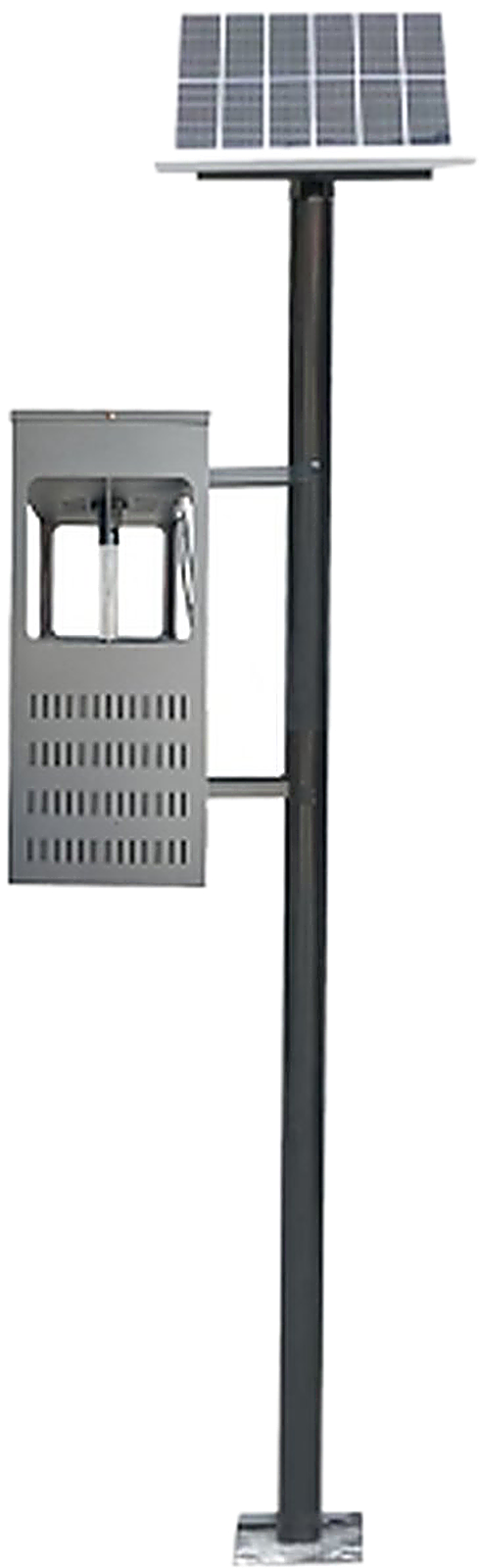
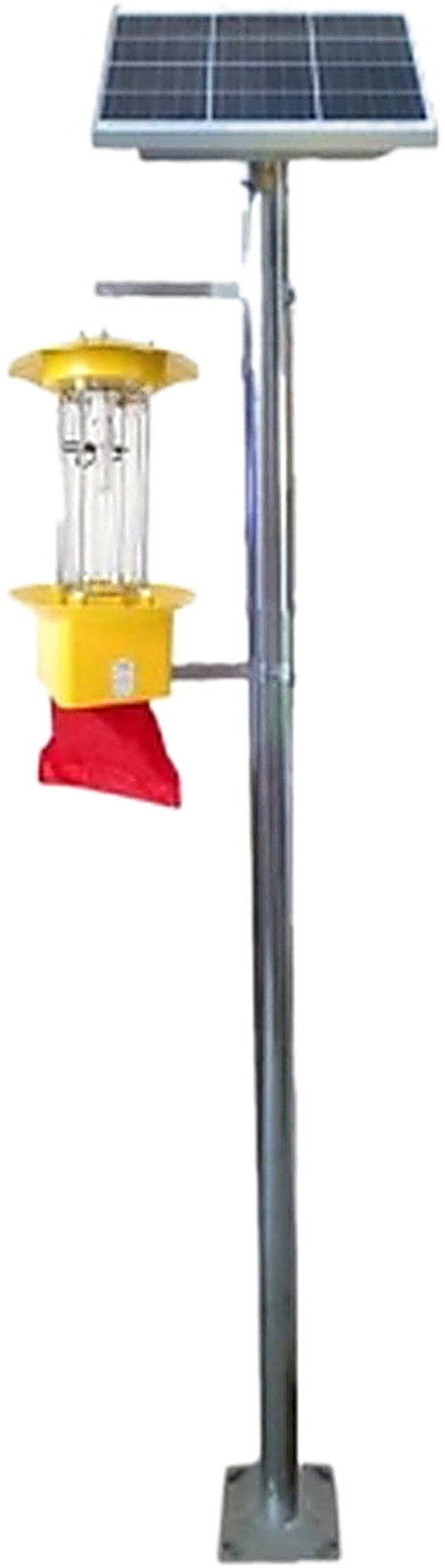
The solar insect killer is the natural anchor of step four, because it needs no grid and can be switched on across hundreds of sites on the same night.
Coordination starts with spacing. In an area wide pest management zone, units should be placed on a consistent grid — typically 40 to 70 metres apart along crop edges and movement corridors — so adults meet a trap no matter which field they leave. Gaps between participants become refuges, so the program maps coverage and recruits the holders of missing squares first.
Because every unit is self-powered, the barrier does not depend on who has electricity. A cooperative can light up a whole hillside in a single season, which is why area-wide pest management programs favor uniform, self-contained traps over grid-tied alternatives.
Timing is the second lever. If half the zone runs its solar bug zapper from dusk and half from midnight, the pests simply use the dark windows to move. Area-wide programs agree on a single operating window — usually dusk to 2 a.m. when most target adults are active — and align any complementary pheromone lures so the two attractants reinforce rather than compete.
Some zones add fixed lure stations at the perimeter to pull migrants inward toward the trap line, tightening the suppression ring.
The quiet advantage of modern farm pest management is data. Each solar insect killer that logs catch counts feeds a shared map. When any sub-zone crosses the agreed threshold, the whole district knows within a day.
That shared signal prevents the classic failure where one grower sprays early, neighbors wait, and the sprayer simply pushes the problem next door. In an area wide pest management design, the trigger is collective, so the response is collective.
Success is measured two ways. The first is the trap count trend: a sustained drop across the whole zone, not just one farm. The second is the economic proof — lower insecticide spend, higher clean-crop percentage, and fewer quarantine interceptions at the packing gate.
Districts that have run coordinated programs for more than two seasons typically report a step-change in stability: outbreaks that used to arrive every year become occasional, and the remaining sprays shrink to spot treatments. That durability is the headline benefit of area-wide pest management over any single-farm effort.


Use this guide alongside the references below to build a complete, defensible program.
For deeper technical and regulatory context, see the FAO Integrated Pest Management and the EPA safe pest control.
Isn’t area-wide management only for government programs? No. Grower cooperatives, irrigation districts and even informal neighbor groups run effective versions. The key is agreement on thresholds and timing, not a government badge.
How many solar insect killers does a zone need? Enough to remove the gaps. A connected grid at 40–70 metre spacing along edges and corridors usually covers a productive zone; the exact number follows the mapped boundary.
Do we still need sprays in area-wide pest management? Often far fewer. The trap line lowers the adult floor so that only genuine hotspots need a targeted, timed application — if any at all.
How long before we see results? Adult catches drop within weeks of full coverage. Economic and residue benefits build over one to two seasons as the breeding pool shrinks.
The lesson of area wide pest management is simple: pests do not respect fences, so neither should your trap line. Coordinated solar insect killer deployment turns a row of isolated devices into a regional barrier that no single farm could build alone.