
Japanese beetle adults arrive in midsummer with little warning. One morning the soybean edges look fine; a week later the leaves are skeletonized and the population has spread across the block. Because adults are strong fliers that feed on more than 300 plant species, a single treatment rarely solves the problem. Effective Japanese beetle control means stacking tactics, and a solar insect killer is one of the most useful layers because it works every night without labor.
The Japanese beetle (Popillia japonica) is both a crop pest and a quarantine concern. Females lay eggs in turf and soil, and the white grubs that hatch feed on roots of grasses, soybeans, and nursery stock. Adults emerge in warm weather, feed in full sun, and aggregate in large numbers. A heavy adult feeding event can strip foliage from fruit trees, ornamentals, and row crops in days.
What makes Japanese beetle control difficult is mobility. Adults fly between hosts by day and are drawn to lights at dusk. Spraying one field while a neighboring hedgerow keeps producing beetles gives only short-lived results; agricultural pest control that ignores the surrounding landscape chases the same flight year after year.
The grub stage adds a second problem. Soil insects are hard to reach once established, and many regions restrict the insecticides once standard for grub suppression. That is why growers are adding nonchemical adult suppression.
Adults feed on flowers, fruit, and leaves, leaving lacy skeletonized foliage behind. They release aggregation signals as they feed, so a few beetles quickly become a dense cluster. Warm, sunny, dry days favor activity; rain and cool nights slow it.
The flight window matters for timing. Emergence usually begins in early to mid summer and continues for six to eight weeks, starting earlier and lasting longer in warm regions. Grubs overwinter in soil and pupate in spring, so the adult surge is predictable year to year even as exact dates shift with weather.
Populations build in turf, hay fields, and grassy waterways. A farm with large grass margins next to soybeans or orchards has its own beetle factory, so any Japanese beetle control plan must account for those reservoirs.
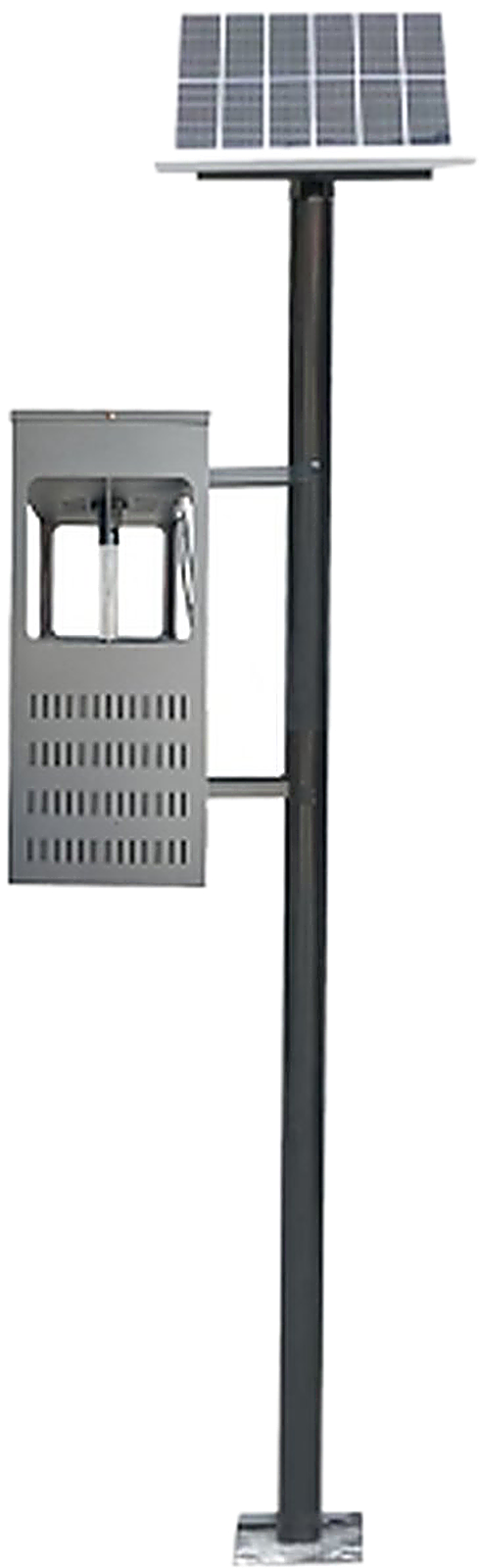
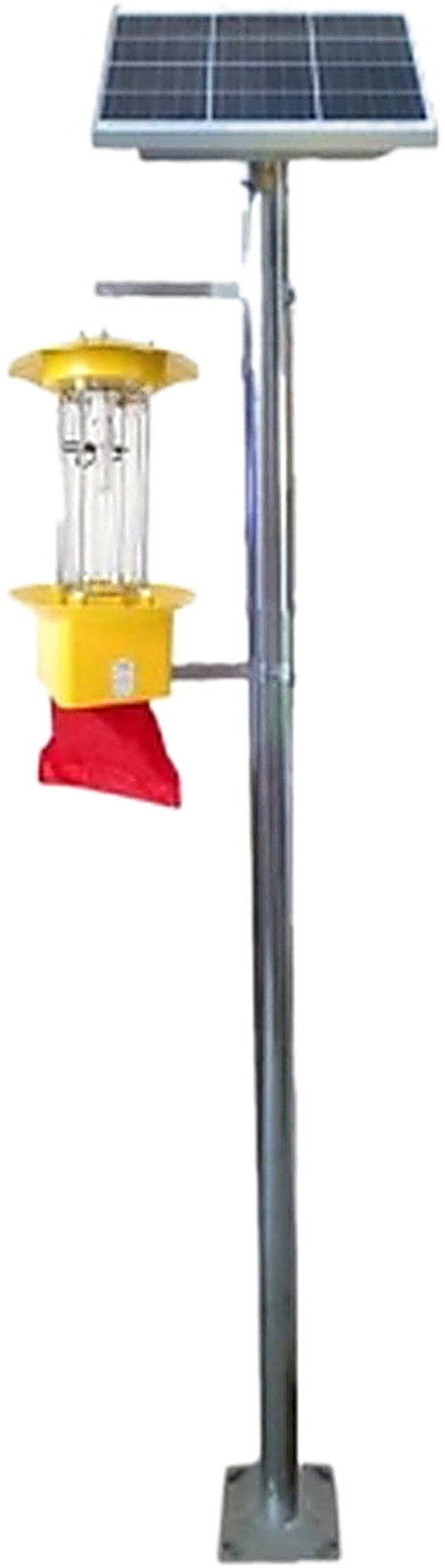
A solar insect killer intercepts the adult stage during its dusk flight. The unit charges by day and switches on automatically at dark, using a UV-rich lamp to draw flying insects into a suction fan or capture grid. Because the trap runs on stored solar power, it covers a narrow but critical flight window that manual scouting and daytime spraying often miss.
Adults are most active in warm afternoon sun, but they also move between host plants and resting sites around sunset. A solar bug zapper operating from dusk into the early night captures beetles dispersing to new hosts. Running nightly through the flight season turns the trap into a continuous suppression tool rather than a one-off reaction.
On farms, wind suction capture is usually preferable to an exposed electrocution grid. Suction reduces sparks, debris, and incidental contact with larger insects and animals, and keeps the catch contained for counting. When measuring Japanese beetle control by trap catch, a clean readable sample is worth more than a loud flash.
Placement decides whether the trap intercepts beetles or simply illuminates an empty field.
A common error is putting a single solar insect killer in the center of a large block. Beetles enter from the edges, so a perimeter ring of traps usually gives better Japanese beetle control than one central unit. Farm pest management is geography work as much as pest work.
No single tool carries a season. The strongest programs combine several compatible layers.
Mow and manage grassy margins where grubs develop. Remove fallen and overripe fruit that draws feeding adults into orchards. Manage irrigation so turf is not kept artificially moist in areas where grub pressure is high. These steps reduce the local population before flight begins.
Where approved, beneficial nematodes or milky spore products can suppress grub populations in soil. Flowering border plants support parasitic wasps and predatory insects that attack eggs and small larvae. Trap crops can pull adults away from the main harvest. A solar insect killer then removes a share of the adults that would otherwise replenish the soil population.
Start running traps before the first adults appear, not after defoliation is visible. Check catch counts two or three times a week during peak flight. Rising counts in a perimeter trap signal that emergence has begun in the adjacent turf, which is the moment to tighten the rest of the program.
Combine trap data with scouting. Look for skeletonized leaves, beetles clustered on sunny leaf surfaces, and fresh fruit feeding marks. Use a threshold based on your crop and market tolerance rather than reacting to a single trap night. The trap supplies the trend; the grower makes the call.


Use this guide alongside the references below to build a complete, defensible programme.
For deeper technical and regulatory context, see the FAO Integrated Pest Management and the EPA safe pest control.
No. It suppresses the flying adult population and provides monitoring data, but it does not kill grubs deep in soil. The best Japanese beetle control combines solar trapping with turf management and, where permitted, biological grub treatments.
Run them from just before expected emergence until catches drop for two consecutive weeks. In most temperate regions that means a mid summer window; in warm climates the season can start in spring and extend into autumn.
Placement and timing determine the impact. Suction traps capture a broad range of night-flying insects, so position them away from flowering habitat and use catch data to avoid over-deployment. They remain far more selective than a broad-spectrum insecticide spray.
Start with the manufacturer’s coverage rating for your crop and layout, then add units where catch counts stay high along a particular edge. Perimeter coverage usually delivers better results than a single central trap.
Japanese beetle control is a season-long job, not a single spray. A solar insect killer gives you nightly adult suppression, a measurable catch trend, and a tool that fits cleanly into a broader farm pest management program. Add it at the field edge, monitor the counts, and adjust the rest of your IPM plan from what the traps tell you.