
Carrots, beets, radishes, parsnips, turnips, and rutabagas share a vulnerable trait: their saleable part grows underground or at the crown, where the larvae of small flying flies do the most damage. Because the adult flies are weak, short-lived, and active at dawn and dusk, a solar insect killer is a natural fit for root vegetable IPM. This guide covers the pests, the trap logic, and field-tested placement.
Unlike leaf-chewing caterpillars, the worst root vegetable pests are tiny flies whose adults lay eggs at the soil surface near the plant. The maggots then burrow down and ruin the crop:
The adults are small, fly low, and are most active in low light — precisely the window a solar bug zapper covers.
The strategy is to intercept the adult fly before it lays eggs:
In agricultural pest control terms, this is a preventive barrier: fewer egg-laying adults equals fewer maggots in the roots.
Root crops sit low to the ground, so mount the trap just above the foliage line — typically 0.6–1.0 m — rather than high on a pole. Position units along field edges and headlands where migrating adults enter, and stagger them every 30–50 m within large beds.
A solar insect killer works best alongside fine-mesh row covers and crop rotation. Together they form a layered defense: the cover blocks what the trap misses, and the trap suppresses the wider flying population.
Effective farm pest management for root crops blends several low-residue tactics:
1. Rotate families so carrot fly and cabbage root fly cannot build up in one spot. 2. Time sowings to avoid the peak egg-lay windows of the main fly generations. 3. Use the trap as a monitor — a sudden jump in catch signals the start of a flight and prompts covering or spraying decisions. 4. Conserve beneficials such as ground beetles and rove beetles that prey on eggs and small larvae.
This is the essence of modern agricultural pest control: observe, then act minimally.
Different root vegetables face different fly generations, so tune the trap timeline to the crop:
Carrot fly has two to three generations per season in temperate zones. The first flight lands just as seedlings emerge; pre-stage traps and keep them running through the summer peak to protect the long, slow-maturing roots.
Beet leaf miner adults appear in late spring. Because the larvae mine leaves rather than roots, the trap’s value here is protecting foliage photosynthesis and preventing premature bolting stress.
These quick crops often bridge gaps between slower beds. Cabbage root fly moves readily across a mixed bed, so a solar insect killer at the bed boundary catches migrants before they settle.
Sticky traps catch a few adults but saturate quickly and need frequent replacement. Chemical drenches control maggots but leave residue and can harm soil life. A solar bug zapper runs unattended all season, captures continuously, and keeps the root zone clean — ideal for markets that demand low-residue produce.



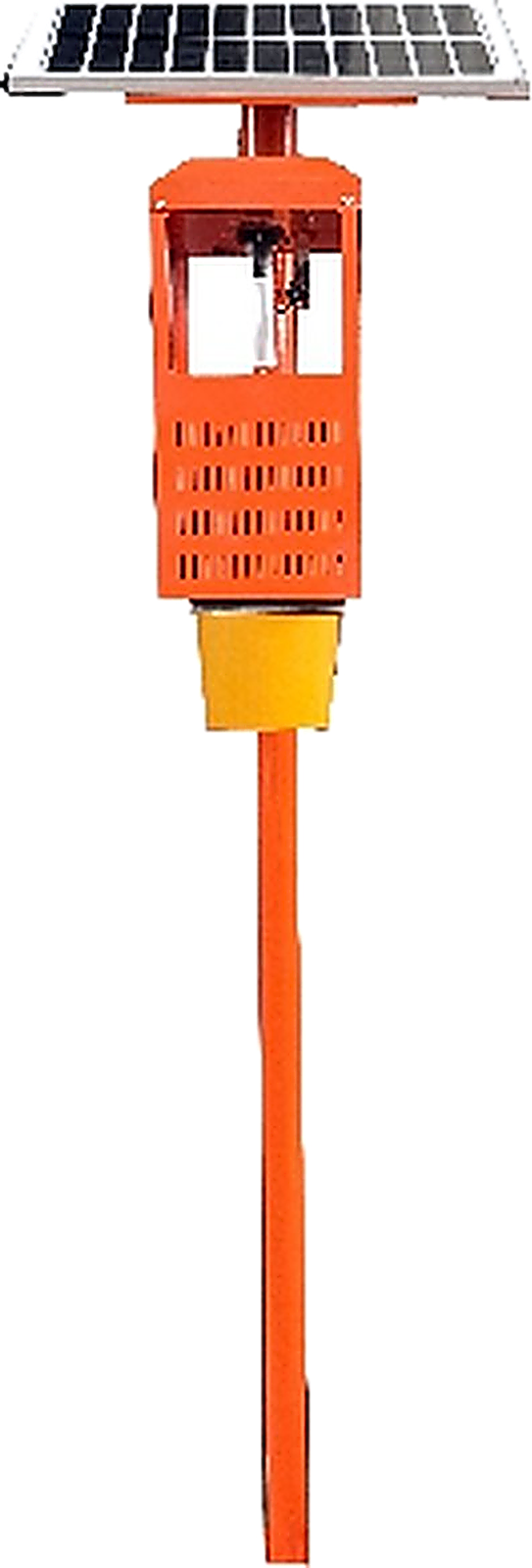
Use this guide alongside the references below to build a complete, defensible programme.
For deeper technical and regulatory context, see the FAO Integrated Pest Management and the EPA safe pest control.
Will a solar insect killer stop carrot fly completely? It sharply reduces the adult population that lays eggs, lowering maggot damage. For full control, pair it with rotation and row covers.
Where should I place the trap in a root vegetable field? Low, just above the crop, and near field edges where adults enter — then stagger units through large beds every 30–50 m.
Is the trap safe around edible crops? Yes. Capture is physical (light + suction) with no spray, so there is no chemical residue on roots or leaves.
How does this fit organic production? A solar bug zapper is a non-chemical, residue-free tool that complements the biological and physical methods organic programs already use.