
Moths and their larval stage — caterpillars — are among the most destructive yet overlooked pests in commercial agriculture. From codling moth in pome orchards to armyworm in field crops, the adult flight that lays the next generation is exactly what a solar insect killer is built to interrupt. This guide explains the science, the placement, and how to fold light trapping into a wider farm pest management plan.
The damage comes in two waves. Adult female moths are quiet and hard to scout, but each one can deposit hundreds of eggs on leaves, fruit, or in the soil. When those eggs hatch, the caterpillars do the real harm:
Because the adult stage is nocturnal and strongly attracted to light, a well-designed solar bug zapper can remove a large share of the population before a single egg is laid.
A solar insect killer does not spray, bait, or poison. It exploits phototaxis — the instinct of nocturnal moths to fly toward light. Key points for agricultural pest control:
The logic is preventive: fewer adults at dusk means fewer eggs at dawn, which means fewer caterpillars to control later.
Mount the trap at or just above the crop canopy where adult moths are actively flying. For field crops, that is typically 1.2–1.8 m; for orchards, position units within the tree line rather than above it. A common starting density is one solar insect killer per 0.5–1 hectare, adjusted after a few weeks of catch monitoring.
Not all “bug lights” are equal. Traps tuned to the UV-A/blue band outperform warm-white or green LEDs for moth species. If your primary pests are codling moth, diamondback moth, beet armyworm, or corn earworm, verify the unit’s emission spectrum before purchase.
A light trap is one tool inside a broader farm pest management program, not a silver bullet:
1. Monitor first. Count nightly catch to time other interventions and to detect population spikes early. 2. Set action thresholds. Combine trap counts with leaf or fruit inspections to decide when a biological or chemical step is truly needed. 3. Combine with biology. Pair the trap with Bacillus thuringiensis (Bt) sprays for active caterpillar outbreaks, and conserve parasitoid wasps that attack eggs and larvae. 4. Use pheromones selectively. Mating-disruption dispensers and the light trap address different life stages and can run together.
This layered approach is the heart of modern agricultural pest control: reduce the adult pool, then manage whatever larvae remain with the least disruptive method.
Grid-powered traps need trenching and cabling across fields; a solar bug zapper drops in without infrastructure. Compared with calendar-based insecticide rounds, light trapping reduces spray frequency, protects pollinators active by day, and leaves no residue — an increasingly important factor for export and organic buyers.

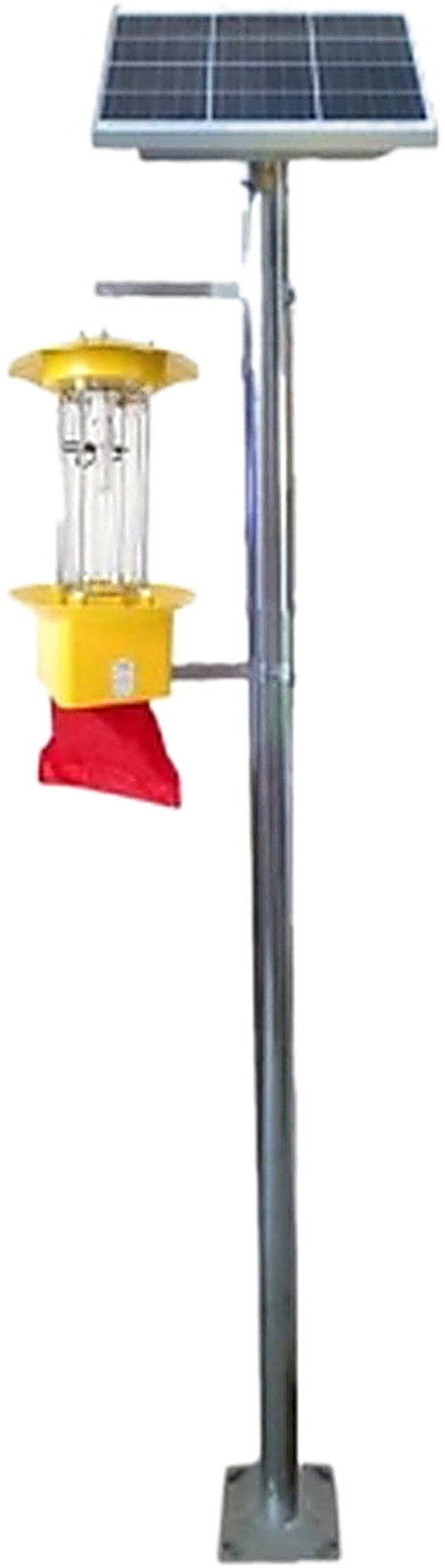


Use this guide alongside the references below to build a complete, defensible programme.
For deeper technical and regulatory context, see the FAO Integrated Pest Management and the EPA safe pest control.
Does a solar insect killer kill caterpillars directly? No. It captures the flying adult moths that lay eggs. By cutting the adult population, it reduces the number of caterpillars that hatch — a preventive, not a curative, control.
Which moths are most attracted to a solar insect killer? Nocturnal Lepidoptera such as codling moth, diamondback moth, corn earworm (Helicoverpa), beet armyworm, and many loopers respond strongly to UV-A/blue light.
How many units do I need per hectare? A typical starting point is one trap per 0.5–1 hectare, refined using your own nightly catch data and canopy height.
Can the trap replace pesticides completely? In many low-to-moderate pressure situations it dramatically cuts spray rounds. For severe outbreaks, pair it with Bt or other IPM steps rather than relying on light alone.