
The Mekong Indochina region — Cambodia, Laos and Myanmar — feeds itself on rain-fed rice, smallholder rubber, cassava and export mango, and its flying-pest pressure is among the most intense in Asia. Across the lower Mekong basin, growers battle rice planthoppers, leaf folders, rubber termite moths, cassava hornworm and mango fruit flies, many of them nocturnal and spray-resistant. This case study shows how commercial and cooperative farms across Mekong Indochina are adding the solar insect killer as a grid-independent layer of agricultural pest control, cutting spray passes while protecting both staple rice and high-value mango exports.
Most of the region’s damaging pests fly at night. The white-backed planthopper (Sogatella furcifera) and brown planthopper (Nilaparvata lugens) explode across irrigated rice in successive generations, the rice leaf folder (Cnaphalocrocis medinalis) rolls leaves and starves the canopy, and mango fruit fly (Bactrocera dorsalis) ruins export fruit overnight. Rubber and cassava blocks deal with their own nocturnal moth complex, including the cassava hornworm (Erinnyis ello).
A physical light trap removes adults before they lay eggs, preventing damage at the source. The solar insect killer fits because it carries its own panel and battery. In a rice cluster outside Phnom Penh, a rubber smallholding in Savannakhet, or a mango orchard near Mandalay, there is often no power line at the field edge. The unit switches on at dusk and off at dawn — exactly when target moths are active — with no fuel, no trenching and no grid connection. For a farm pest management plan built around remote, off-grid holdings, that self-sufficiency is the whole point.
Growers in Mekong Indochina fight a recurring set of flying insects:
All have nocturnal adult stages that respond to light-based attraction, which is where a well-placed solar insect killer earns its keep in agricultural pest control across the basin.
A 260-hectare rice and mango operation near Phnom Penh deployed 120 units along paddy bunds and mango block margins, mounted 1.6–2.0 metres high so the light sat just above the canopy. Mango is a high-value, export-sensitive crop, so the operation wanted to cut calendar-based spraying before fruit set.
Over two seasons the farm recorded a 34% drop in mango fruit fly rejection at packing and a 28% reduction in insecticide volume on rice versus the prior year. The biggest gain was labour: scouting trips fell because trap catches gave an early warning of rising planthopper pressure. The solar bug zapper style traps ran through the monsoon on battery alone.
Around Savannakhet, a cluster of rubber and cassava smallholders totalling roughly 210 hectares used 95 units shared across the cluster, placed on common boundaries and along access lanes. Cassava hornworm and the rubber termite moth complex were the priority pests.
After one full year the cluster reported a 41% reduction in hornworm defoliation requiring intervention and a visible drop in secondary borer damage on young rubber. Because the solar insect killer leaves no chemical residue, the cluster widened its spray-free window, which simplified its cross-border trade paperwork.
In the irrigated belt near Mandalay, a 180-hectare rice and pulse holding used 78 units at field edges and along irrigation canals. Rice planthoppers and leaf folders were the main targets.
The holding measured a 26% improvement in standing rice yield and a 22% cut in insecticide use versus the prior year. The shared-boundary placement also reduced neighbour-to-neighbour pest migration, a recognised benefit in dense smallholder landscapes.
| Site | Crop | Units / Area | Chemical cut | Key pest reduction |
|---|---|---|---|---|
| Cambodia | Rice + mango | 120 / 260 ha | 28% | Fruit fly −34% |
| Laos | Rubber + cassava | 95 / 210 ha | 31% (intervention) | Hornworm −41% |
| Myanmar | Rice + pulses | 78 / 180 ha | 22% | Planthopper down |
Across all three, the common thread was fewer spray trips and better data. Trap catch counts became the trigger for any residual spraying, replacing a fixed calendar that often sprayed whether pests were present or not.
Mekong Indochina swings between monsoon and dry season, so the units need sealed, IP65-rated housings and corrosion-resistant poles. Mounting height matters: too low and the light is lost in undergrowth, too high and it competes with farm lighting. The sites settled on 1.6–2.2 metres depending on crop canopy. Monthly tray emptying and a quick panel wipe kept catch rates steady through the wet season.
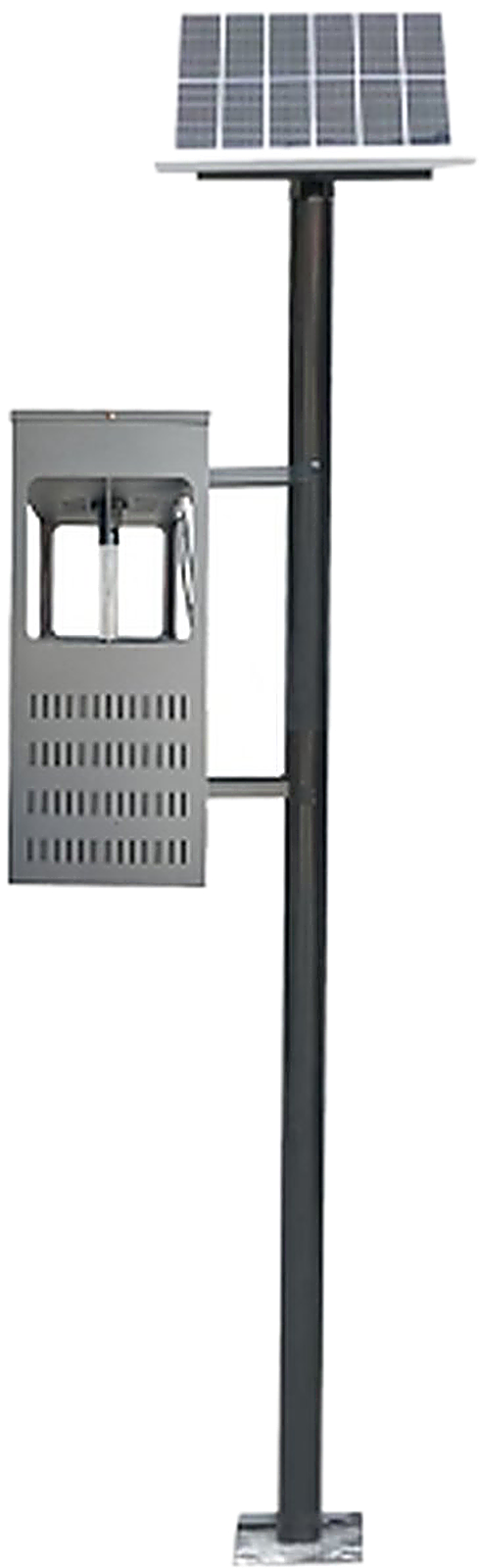



Use this guide alongside the references below to build a complete, defensible program.
For deeper technical and regulatory context, see the FAO Integrated Pest Management and the EPA safe pest control.
Will a solar insect killer work through the Mekong monsoon season?
Yes. The battery is sized for several consecutive cloudy days, and the trap only runs at night, so the long, sunny dry-season days actually top it up quickly.
Does it replace all insecticide use on a rice farm?
No. It is a physical adult-stage tool that pairs well with cultural and biological control. Most sites cut spray volume by a fifth to a third rather than eliminating it.
Is it safe next to residue-sensitive export crops like mango?
Yes. It is a trap, not a spray, so it leaves no harvest residue, which is why export-focused growers adopted it first.
How many units does a Mekong farm need?
Sites used roughly one unit per 1.5–2 hectares of target crop edge, tightening spacing along known flight corridors and shared boundaries.
Can smallholders share units cost-effectively?
Yes. The Lao cluster showed that placing solar insect killer traps on shared boundaries lets neighbouring plots benefit from the same light trap without doubling the count.